AI Readiness Assessment
Are you ready to trust AI agents?
Agents promise to move AI from helping people work to doing the work itself. But an agent is only as safe as the data it can reach, and only as useful as the data it understands. Telana’s AI Readiness Assessment shows you exactly where you stand before you invest in AI agents, and what to do next.
Find the gaps, fix the foundations, and build a practical AI roadmap in weeks, not months.
Complete the form to learn more about our AI Readiness Assessment.
An AI readiness assessment tells you whether your organisation can adopt AI safely and get value from it before you commit more budget. Telana’s assessment covers everyday AI, such as a Microsoft 365 Copilot rollout, and custom enterprise AI built on your own data. It answers three questions:
- What can go ahead now?
- What has to be fixed before enterprise AI is built on top?
- Where should you start?
Most organisations we assess are keen to use AI. The gaps are rarely in appetite or culture. They are in controls, governance and foundations: who has standing admin access, which content is overshared, whether the data platform is safe to connect to, and whether anyone owns AI policy. Copilot and AI agents act as the user, so they can find anything that user can reach. Readiness means knowing that is acceptable before AI scales across the business.
What the assessment covers
Foundational Technology Readiness
Using PowerReview, our own assessment tooling, we identify security gaps, vulnerabilities and configuration drift across your Microsoft and/or Google estates covering:
- Identity and access management
- Data protection
- SharePoint and Drive oversharing
- AI agents and extensions
- Licensing and foundations
- Governance and settings
People and Process Readiness
Through surveys, interviews and workshops, we build a picture of your operating model, governance, capabilities and approach to change. That means understanding:
- Your teams’ appetite, capability and capacity for AI
- The KPIs and pain points that matter to the business
- Your champions, your risks and the use cases worth pursuing first
Our assessment runs across eight workstreams. Each one produces findings, recommendations and a plain statement of what it means for AI readiness.
- Vision and business alignment: your AI strategy, objectives and known use cases, and whether AI spend is linked to business goals.
- Microsoft 365 and Azure: security and governance posture against baseline controls, including privileged access, guest access, public groups, network exposure and resilience.
- Active Directory: the health and exposure of your on-premises directory. Identities synced to the cloud are the identities AI acts as.
- Data classification: Purview sensitivity labels, data loss prevention, retention and oversharing across SharePoint, OneDrive and Teams.
- Governance and operating model: AI policy, shadow AI, change capacity, process and FinOps for controlling AI spend.
- Copilot adoption: enablement, support, audiences and how value is measured.
- Data platform: whether your data platform is secure, structured and governed enough to act as a source for AI.
- Microsoft licensing: what your current licences cover, and what the recommended controls would need.
What you Gain
Complete Visibility: A consolidated, executive-ready AI Readiness Report detailing exactly where your organisation stands.
Recommendations and Actionable Roadmap: A set of recommendations based on the findings, highlighting AI readiness impact, forming an actionable roadmap for you to deploy.
High level use case: A defined use case, with clear ROI and defined business impact to measure against
Want the full picture first?
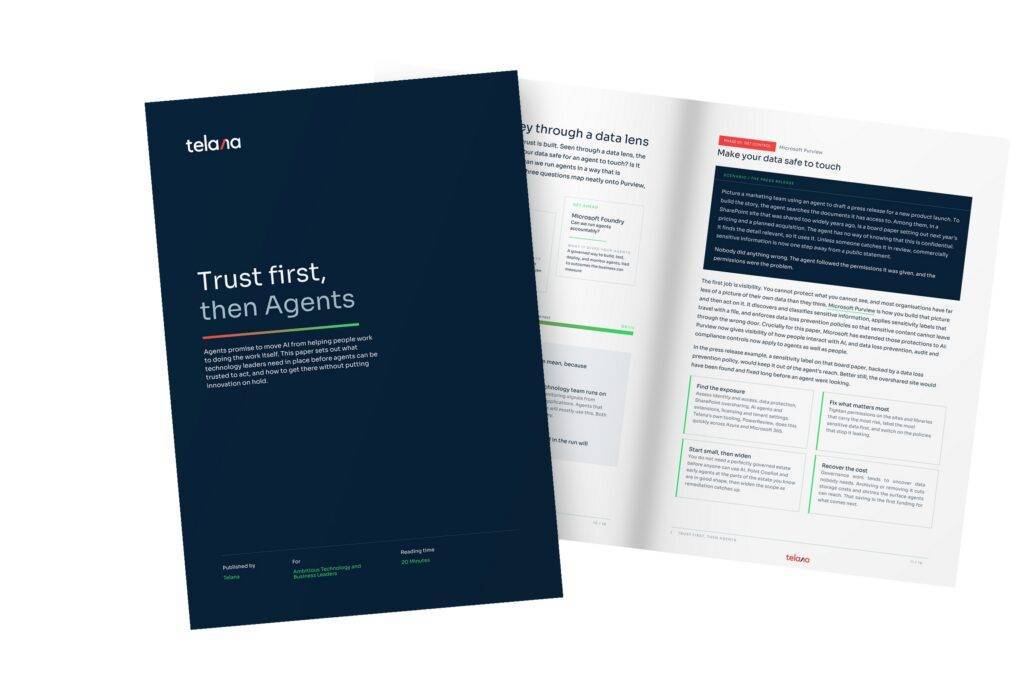
Our whitepaper, Trust first, then Agents, explains why data is the foundation of trustworthy AI and how to build it without slowing down innovation.
Frequently Asked Questions
What is an AI readiness assessment?
It is a structured review of whether your organisation can adopt AI safely and successfully. It covers strategy, security and identity, data protection, governance, adoption, your data platform and licensing. It ends with prioritised recommendations and a phased roadmap.
What if we score low on readiness?
That is genuinely useful information, and common. A low score maps the specific gaps, in data, platforms, governance, or capacity, that need attention first. It tells you where to start rather than telling you to stop.
What platforms does it cover?
The technical reviews cover Microsoft 365, Azure and Active Directory. It also covers Google Cloud and Google Workspace. The data platform review covers the platform you use for reporting and analytics, whether it is run in-house or by a partner.